
Tiberius Bridge and Borgo San Giuliano: a visitor’s guide from Rivabella
Two thousand years of history, the 2026 restoration and the new lighting from mid-December: what to see at the Tiberius Bridge and in Borgo San Giuliano, and how to get there from Rivabella.
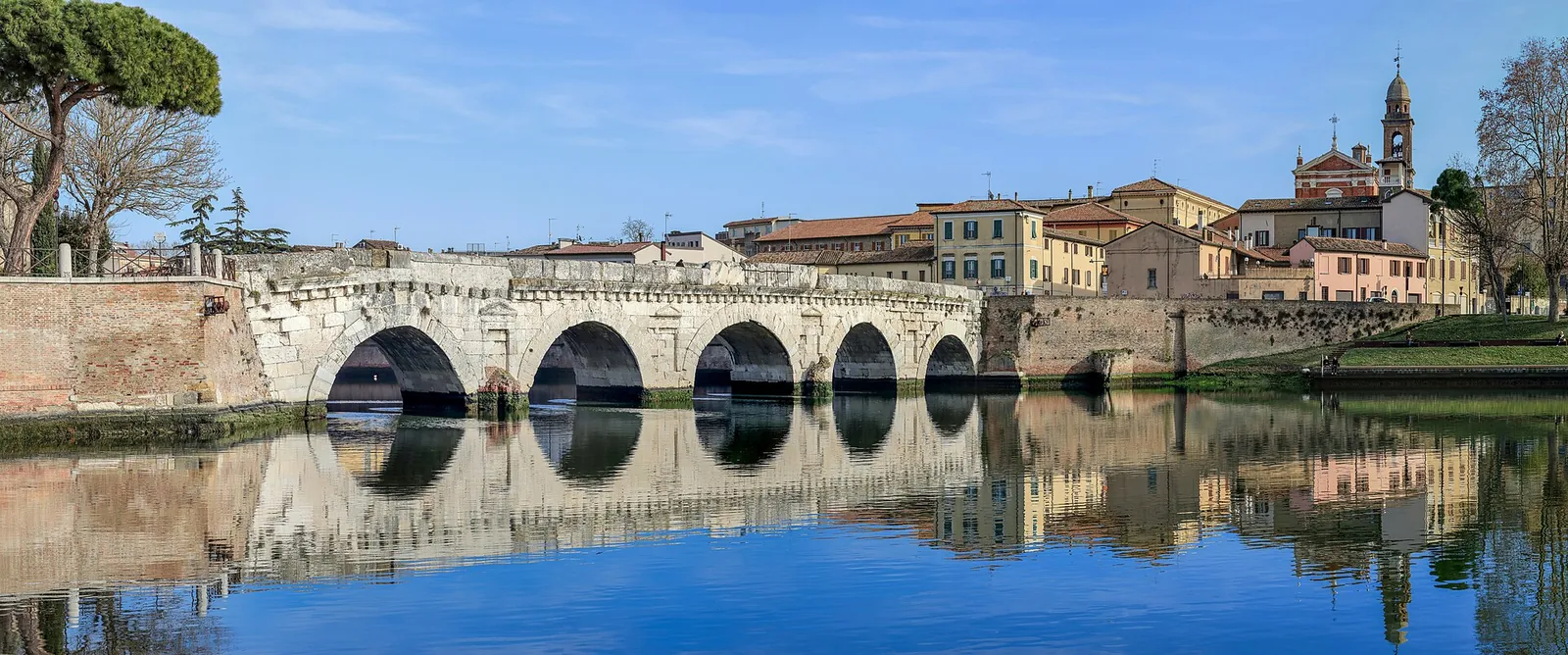
If you ask us for one thing to see in Rimini besides the sea, we almost always say the Tiberius Bridge, the Ponte di Tiberio. It is two thousand years old, you can walk across it at any hour without a ticket, and on the far side is Borgo San Giuliano, the old fishermen’s quarter with its painted houses and the murals dedicated to Fellini. This winter there is one more reason to go: the restoration that began in May 2026 is in its final weeks and, according to the city council, the new lighting is due to switch on by mid-December. Here is what to know before you go, and how to get there from Rivabella.
At a glance
- Where
- Rimini, between the end of Corso d’Augusto (historic centre) and Borgo San Giuliano, on the old bed of the Marecchia river.
- When
- From 9 November to 4 December 2026 the bridge is closed to pedestrians while the scaffolding comes down; you cross via Piazza sull’Acqua or the floating walkway on the sea side. New lighting expected by mid-December.
- Hours
- Always open, day and night.
- Tickets
- Free.
- From the hotel
- About 3 km. Fifteen minutes by bike along the port canal; by bus from the stop 20 metres from the hotel you reach the centre in about 15 minutes, then a ten-minute walk.
Checked on 16/11/2026 on Altarimini and Rimini Notizie.
Two thousand years and five arches
Work began in 14 AD under the emperor Augustus and was finished in 21 AD by his successor Tiberius: both names are still carved along the parapets, which is why locals also call it the Bridge of Augustus and Tiberius. It is built of white Istrian stone, has five arches, and is just over 62 metres long and eight and a half wide. The Via Aemilia started here on its way to Piacenza, and a little further on the Via Popilia branched off to the north: this was Rimini’s exit towards the whole Po valley.
It has survived floods, earthquakes and a war. In September 1944 the retreating German army tried to blow it up, but the charges failed: it was the only bridge over the Marecchia left standing. Until a few years ago cars still drove over it; since 30 May 2020 it has been closed to traffic. Cross it slowly and look down: the paving is the ancient one, with the ruts left by cart wheels.
The 2026 restoration and the new light
In May 2026 the bridge was wrapped in scaffolding built so as not to touch the Roman stone, and from June the Venetian firm Lares cleaned the faces and arches following a minimal-intervention approach: deposits and crusts removed, original patina kept. The project was agreed with the heritage authority, the Soprintendenza. Cleaning is finished; from 9 November the scaffolding is being dismantled, the paving completed and the lighting scenes tested, which is why the bridge cannot be crossed until 4 December. Between San Giuliano and the centre you can still walk along Piazza sull’Acqua or over the floating walkway on the sea side.
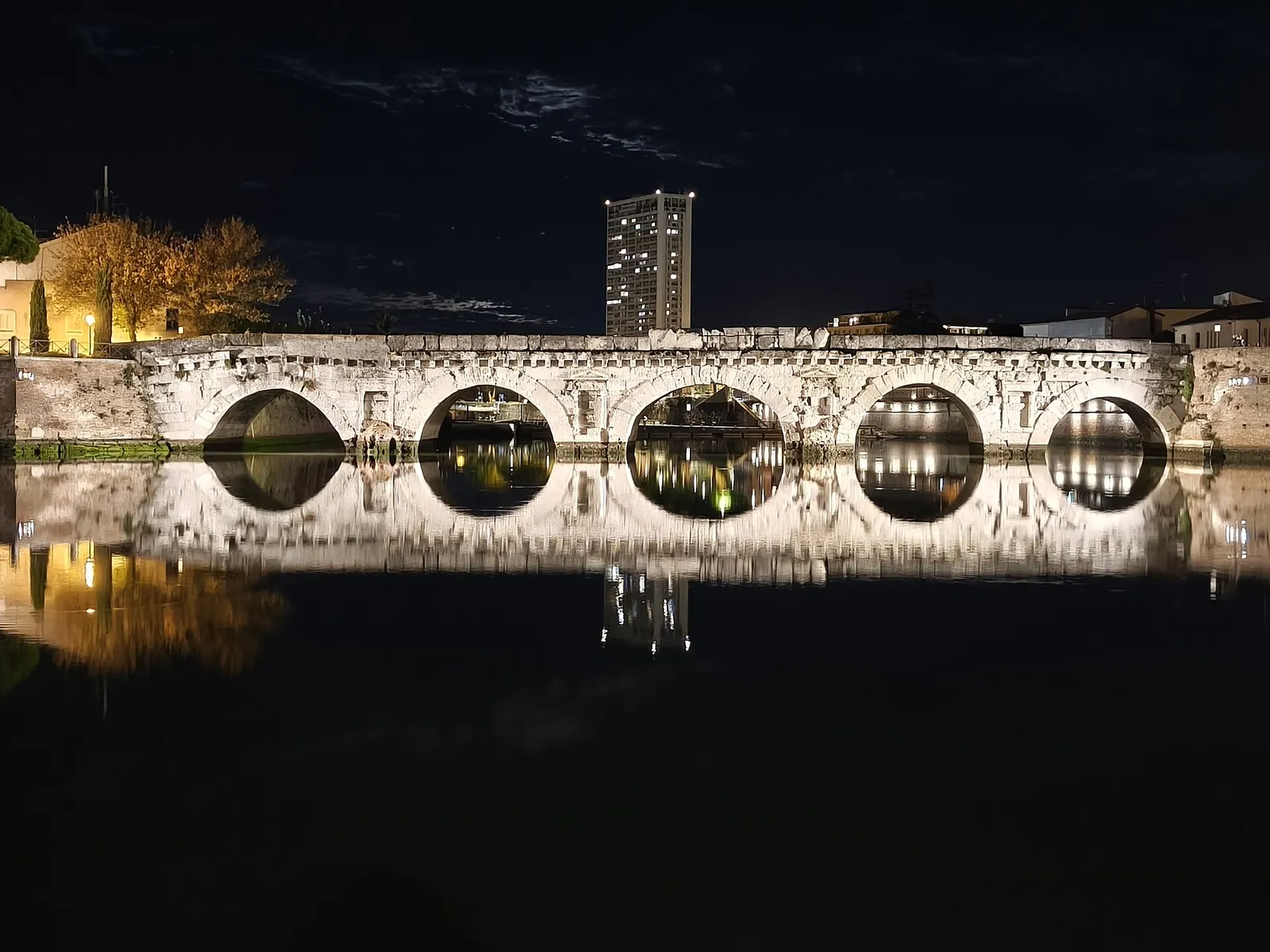
The part we are most curious about is the new lighting, designed by the studio Light Company: adjustable projectors that reproduce the path of the sun at night, with shades of white that change through the hours, plus dedicated lights for the footbridges and the steps of Piazza sull’Acqua. The permanent switch-on is expected by mid-December, among the novelties of the Christmas season together with the Christmas Village on the beach. If you are staying with us in December, it is worth the detour after dark.
Piazza sull’Acqua and the park
One thing that surprises first-time visitors: no river flows under the bridge. The Marecchia was diverted further north in the 1930s and the old riverbed became Parco XXV Aprile, which everyone calls Parco Marecchia. Under the arches a basin of still water remains, the invaso, and that is why the bridge reflects so well. On the park side is Piazza sull’Acqua, a wooden tiered terrace facing the bridge: in summer it hosts concerts, in the other seasons it is the place to sit with a coffee or a piadina. On the sea side a floating walkway lets you see the arches head-on, and at the entrance to the Borgo a small archaeological park displays the stones of the bridge recovered from the riverbed. With children or a dog it is a perfect corner: grass, benches, no cars.
Borgo San Giuliano: murals, lanes and osterie
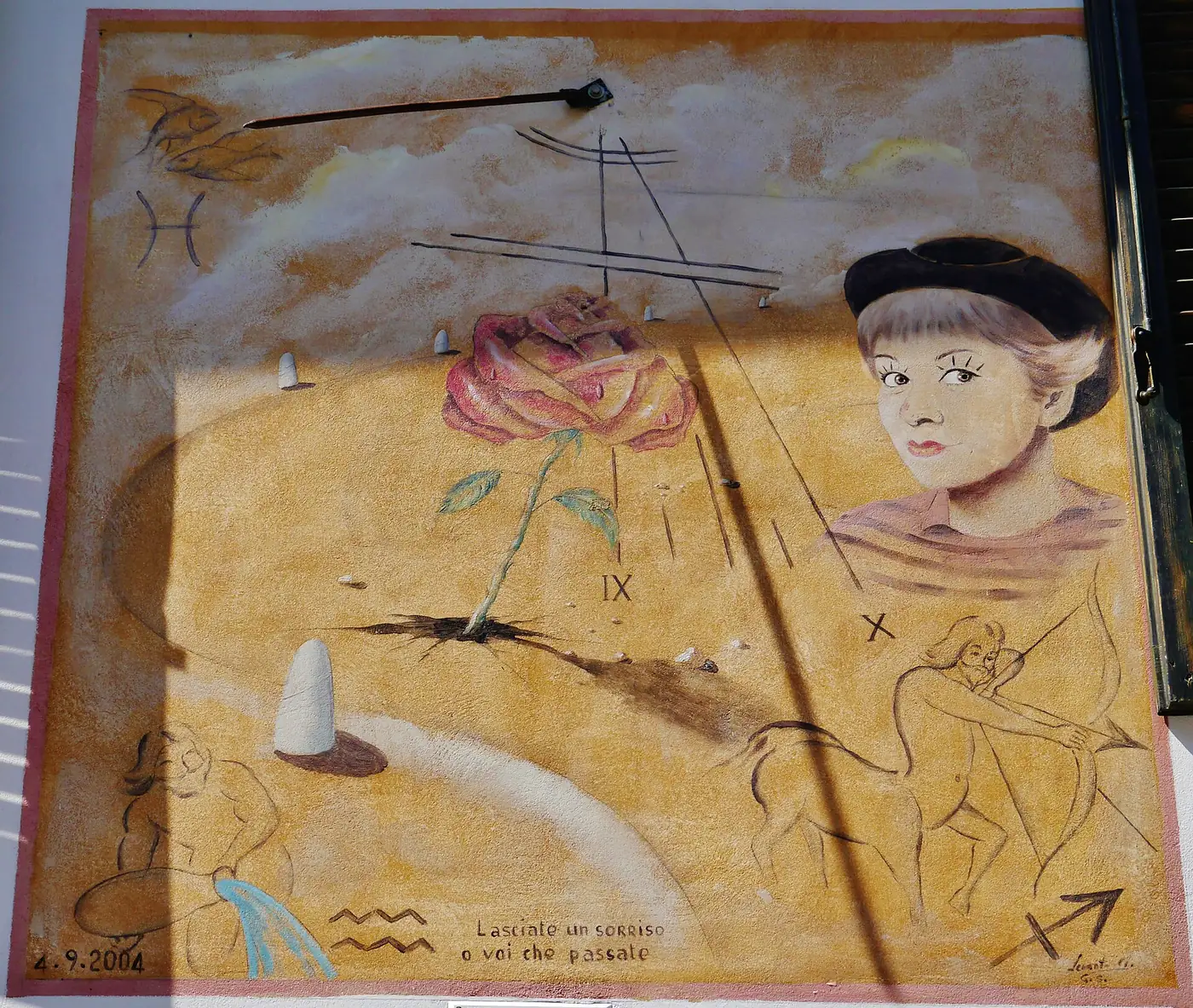
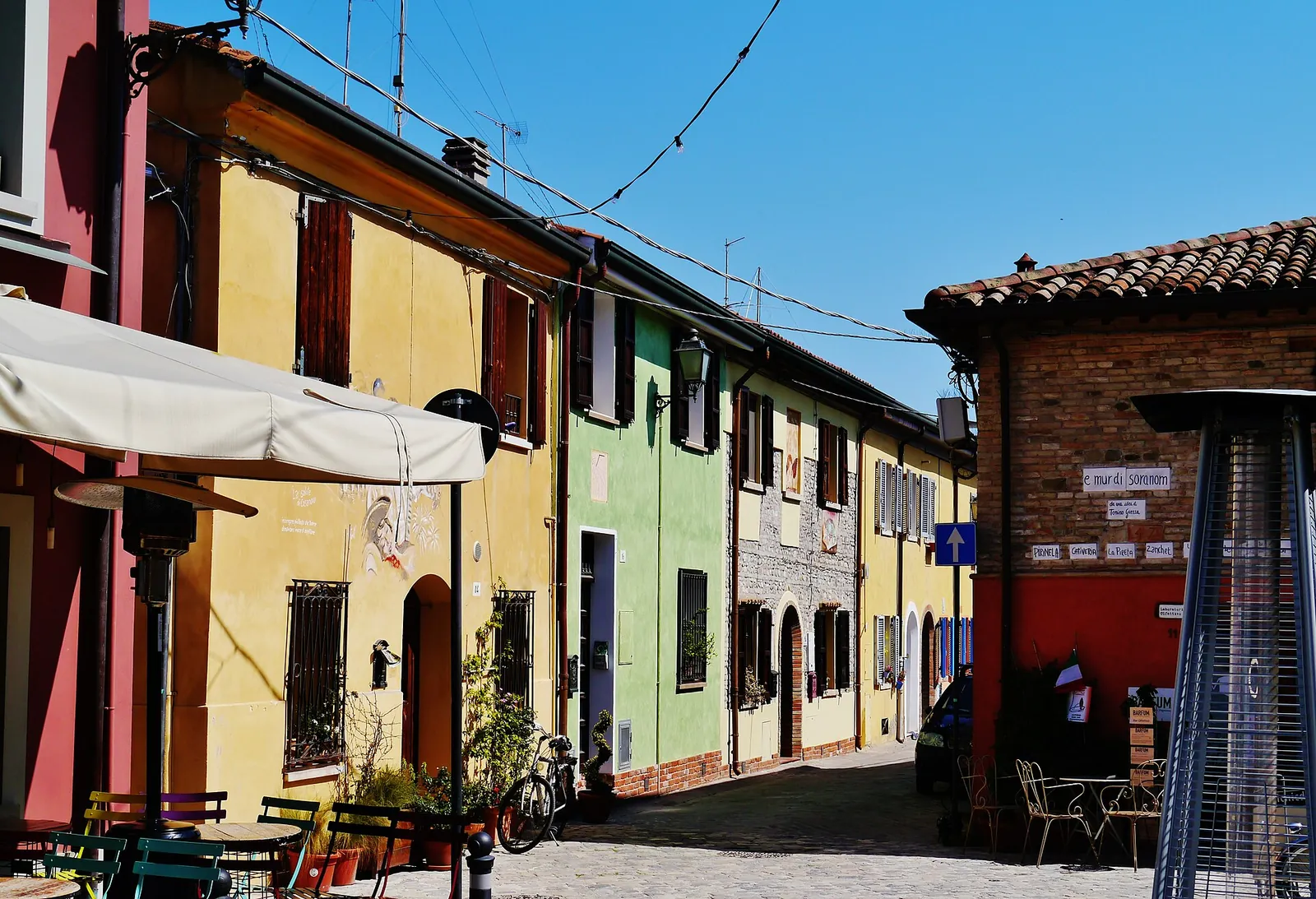
Across the bridge you enter Borgo San Giuliano, the quarter of fishermen and sailors outside the city walls. Today it is a web of cobbled lanes with low houses painted yellow, red, green and blue. The murals were born with the Festa de Borg, the street festival the Società de Borg has organised since 1979 every two years on the first weekend of September: the 2026 edition, the twenty-third, ran from 4 to 6 September and the next one is normally two years later. After Fellini’s death in 1993 many walls were dedicated to the director and his films: you will recognise Gelsomina, the characters of Amarcord, the ocean liner Rex. Each festival adds or renews a few walls, so the Borgo changes a little every time.
There is no set route: getting lost is the right way to do it. Two useful landmarks are Via Marecchia, the main street, and the church of San Giuliano Martire, which keeps on its high altar the Martyrdom of Saint Julian by Paolo Veronese. The Borgo is full of osterie and small restaurants, many with tables outside even in winter on sunny days: at weekends it is wise to book. We do not have a restaurant, but tell us what you like and we will gladly point you to the right place.
How to get there from Rivabella
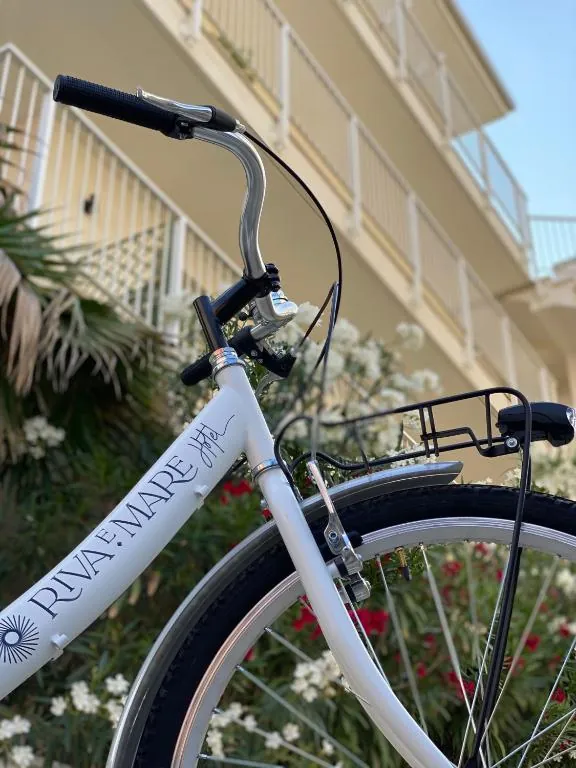
The bridge is about 3 km from the hotel, all on the flat. By bike, with our free bicycles, it takes a quarter of an hour: follow the seafront south to the port canal, ride up the port to the first road bridge and you are in front of the Borgo five minutes later. By bus the stop is 20 metres from the hotel and the centre is about 15 minutes away; from the Arch of Augustus the bridge is at the far end of Corso d’Augusto, a ten-minute walk through Piazza Tre Martiri and Piazza Cavour. On foot from Rivabella it is 35–40 minutes along the sea and the port. If you have a car, the Tiberio car park is next to the bridge, but at weekends it fills up early.
Our tips
- The right time: reach Piazza sull’Acqua half an hour before sunset, wait for the bridge to light up, then have dinner in the Borgo. From mid-December, with the new lighting, even better.
- Until 4 December you cannot cross the bridge: go anyway, you see it perfectly from the floating walkway and the park.
- A full loop takes a couple of hours: bridge, Borgo, then Corso d’Augusto to Piazza Cavour, the Tempio Malatestiano and the Arch of Augustus. By bike you need only twenty more minutes to get back to Rivabella along the sea.
- For photos: in the morning the light comes from the park side; in the evening look for the reflection from the corner of Piazza sull’Acqua, when the water of the basin is still.
If you would like help planning the day, or want to know whether the new lighting is already on for your dates, write to us on WhatsApp or by email: we will tell you how things stand that day.
Hotel Riva e Mare · Rivabella, Rimini